
SYSTEM THINKING
Optimising Port Calls for Offshore Operations: A Systems Thinking Approach
04/11/2026
Offshore marine logistics and port call execution represent some of the most complex operational environments in modern commerce. Preparing a vessel for an offshore campaign involves coordinating an array of moving parts: onshore procurement, quayside loadouts, regulatory compliance, marine terminal restrictions, agent scheduling, and multi-vendor coordination.
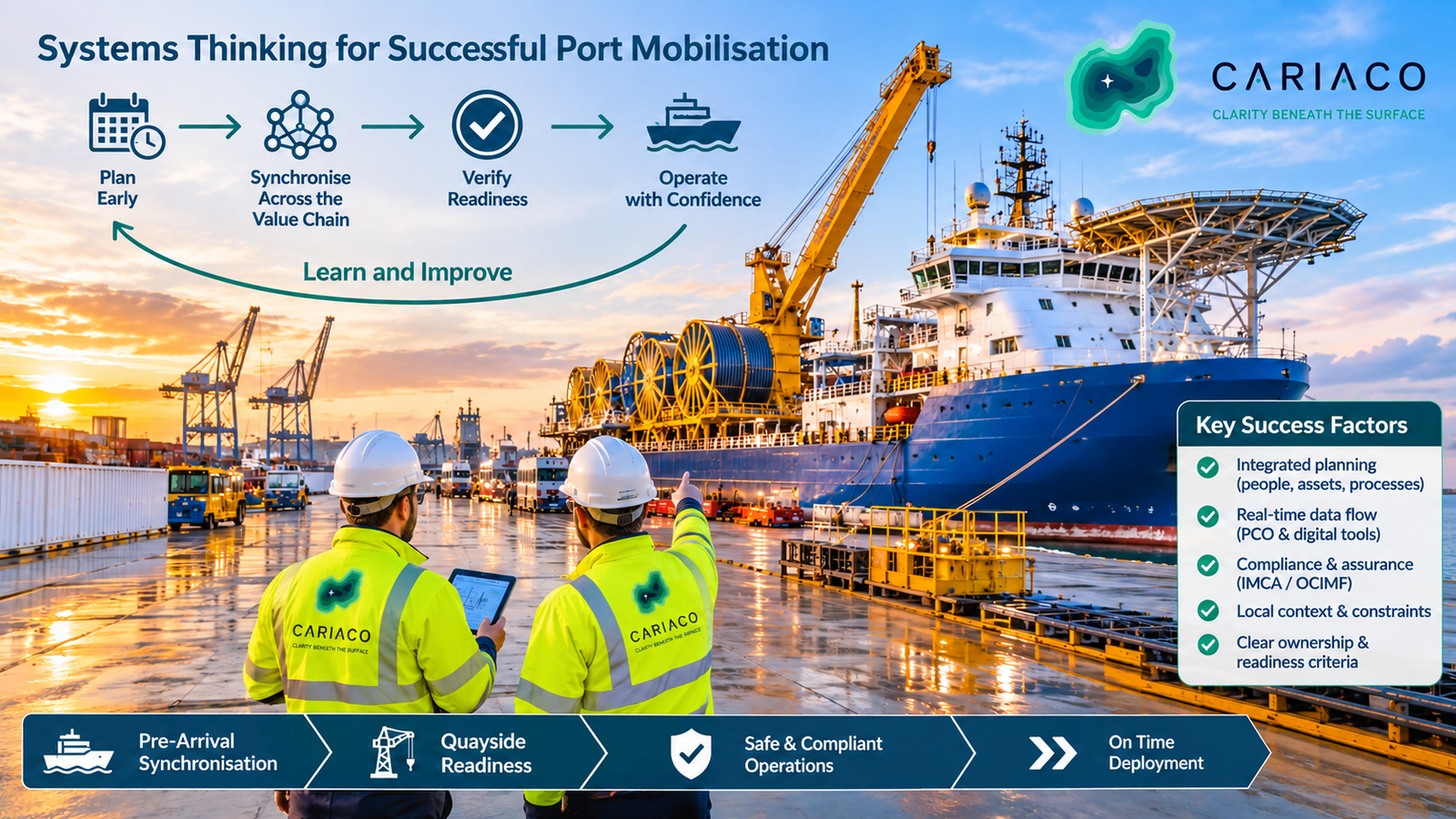
Traditionally, managers attempt to optimise these operations by breaking them into isolated tasks and managing each department independently. However, local efficiency rarely translates to overall system performance. When a port call or vessel mobilisation is treated as a collection of disconnected events, minor oversights (such as a delayed document, an unverified draft limit, or an uncoordinated tug dispatch), cascade into severe delays, idling vessels, and inflated operational costs.
To achieve genuine operational efficiency, contractors must transition from reductionist management to systems thinking. By viewing port calls and vessel preparations as an interconnected network of goods, information flows, feedback loops, and human mental models, operators can eliminate friction, reduce idle time, and build long-term operational resilience.
Re-Architecting Port Call Preparation as an Integrated System
A port call or offshore mobilisation is not a single linear event; it is an integrated sub-system within a broader supply chain network. Treating vessel mobilisation or port arrival as a last-minute handoff between onshore teams and marine crews frequently leads to sub-optimisation, where individual entities optimise for their own targets at the expense of the whole operation.
To prevent this, vessel superintendents and project managers must establish a centralised, systematic pre-arrival framework well before the vessel reaches the port perimeter.
- Operational Convergence and Readiness Declaration: Preparing for a port call requires the early planning of a systemic convergence of onshore engineering, equipment procurement, quayside logistics, and deck preparation into a single synchronised timeline. Rather than managing sub-scopes in isolation, systems thinking brings together all physical components, technical approvals, lifting arrangements, and operational processes at the quay. This structured convergence ensures that every technical requirement is satisfied on location before vessel arrival, and culminates in a formal, verified declaration of readiness to depart berth and proceed offshore to operate once the mobilisation is completed.
- Clear Ownership and Readiness Verification Goal: A designated mobilisation or interface lead should coordinate everyone against one agreed programme. Readiness reviews should distinguish between the port being ready to receive the vessel, the vessel being ready to sail and the installation spread being ready to operate offshore, with clear acceptance criteria and named owners for all the actions.
- Pre-Arrival Synchronisation and Action Readiness: Parallel to physical convergence, pre-arrival planning establishes digital and administrative readiness before the vessel enters port limits. Systems-led pre-arrival incorporates voyage verification, regulatory filings, customs clearances, vendor due diligence, and disbursement accounting into a unified workflow. By sharing standardised data across centralised digital platforms, port agents, suppliers, berth planners, and terminal personnel receive real-time updates, ensuring all parties are pre-positioned and ready for immediate action the moment the vessel arrives.
- Integrating Assurance and Terminal Protocols: Standardised vessel inspection regimes, such as the International Marine Contractors Association (IMCA) eCMID system and the Oil Companies International Marine Forum (OCIMF) Offshore Vessel Inspection Database (OVID/OVIQ4), must be embedded into the pre-arrival phase. Verifying inspector accreditation, officer qualification matrices, and vessel safety documentation prior to port entry eliminates compliance bottlenecks at the berth.
- Understanding the Local Operating Environment: Local working culture, union arrangements, port practices and actual processing and delivery times need to be built into planning early. Assuming a standard way of working can be a costly mistake. This applies across regions, including European ports with specific union agreements and access restrictions, or projects in African countries with different administrative processes and local-content requirements. Each location needs to be understood on its own terms.
- Aligning with Terminal Boundaries: Marine Terminal Information Booklets (MTIS) establish strict physical, environmental, and safety parameters for berthing. Integrating these terminal parameters into early passage planning prevents costly mismatches between vessel capabilities and quay infrastructure.
High-Leverage Interventions: Digital Standardisation and Real-Time Data Flow
In systems theory, changing physical parameters (such as adding more lorries or increasing vessel speed) often yields minimal improvements. True operational transformation occurs at higher leverage points: re-engineering information flows and altering system rules.
Historically, port calls have operated under a “first come, first served” paradigm. This rule incentivises a destructive system behaviour known as “Sail Fast, Then Wait” (SFTW), where ships burn excessive fuel to reach a port, only to spend days idling in anchorage waiting for berth or service availability.
Port Call Optimisation (PCO) replaces this reactive pattern by standardising operational data exchange through secure Application Programming Interfaces (APIs) and unified industry data models:
- Standardised Timestamps: Exchanging unambiguous, real-time data points—such as Planned Time of Arrival at Pilot Boarding Place (PTA PBP), Requested Time of Arrival Berth (RTA Berth), and Planned Time of Departure Berth (PTD Berth)—allows all stakeholders to synchronise their activities.
- Synchronised Service Delivery: When ship managers, port authorities, berth planners, pilots, and tug operators share a single source of truth, service providers can plan capacity accurately. Pilots and tugs arrive precisely when needed, quayside cranes are pre-positioned, and hinterland transport is scheduled seamlessly.
- Just-In-Time (JIT) Arrivals: By receiving reliable RTA timestamps while still at sea, vessels can adjust their transit speed to arrive exactly when the berth is ready. This reduces fuel consumption, lowers emissions, and minimises congestion in port waiting areas.
Managing Time Delays, Buffers, and System Resilience
Time delays between cause and effect are a major source of instability in maritime supply chains. Upstream disruptions in onshore equipment manufacturing or land transport frequently compress the available port mobilisation window, creating intense schedule pressure on quayside crews.
When schedules are compressed, systems often enter a reinforcing feedback loop of operational risk: time pressure leads crews to rush, bypass procedures, or work through fatigue, which increases errors and causes further operational disruption. Over time, recurring compromises can trigger a systemic trap known as the “drift to low performance,” where diminished safety and operational standards become normalised.
Systems thinking provides two essential structural interventions to counteract these dynamics:
- Strategic Buffer Allocation: To protect the critical path, such as heavy-lift cargo operations or primary mobilisation tasks, accessory activities must be decoupled. Tasks like pre-rigging lifting gear, pre-lashing deck cargo, verifying crew matrices, and clearing administrative permits should be executed outside the critical path as stabilising buffers.
- Balancing Feedback Loops: Establishing absolute operational standards through Management of Change (MoC) protocols, daily residual risk evaluations, and strict stop-work triggers creates balancing loops. These mechanisms automatically stabilise the system under pressure, ensuring that operational limits are respected regardless of schedule demands.
Conclusion: Dismantling Silo Mentality through Systems Thinking
Ultimately, the greatest barrier to efficiency in offshore preparations and port operations is the silo mentality. When port agents, vessel operators, terminal managers, and onshore logistics teams operate in isolation, they create bounded rationality. Making decisions that appear logical within their narrow departmental boundaries but create chaos across the wider system.
Overcoming this requires a fundamental shift in how maritime professionals perceive their operational environment. As systems thinker Sandeep Swadia observed:
“Systems thinking is your ability to see hidden patterns from parts that you can observe… The hardest system to redesign is the one you build inside your own head.”
Dismantling organisational silos requires dismantling the mental models that created them. When maritime and operational leaders stop viewing a port call as a series of isolated transactional handoffs and start managing it as a dynamic system, operational friction disappears. By aligning shared goals, standardising digital information flows, and designing resilient operational structures, the offshore marine industry can achieve unprecedented levels of efficiency, safety, and environmental sustainability.
Written and edited by
Francisco Tinoco (CARIACO LTD) and Javier Gallardo (SEALINKS)
References
- International Maritime Contractors Association [IMCA] (2024) Guidance on the IMCA eCMID System. IMCA M167 Rev. 5. London: IMCA.
- Meadows, D.H. (2008) Thinking in Systems: A Primer. White River Junction: Chelsea Green Publishing.
- Offshore Construction Associates (2021) Best Practice for Vessel Mobilization (Part 3). OCA Insights.
- Oil Companies International Marine Forum [OCIMF] (2021) Marine Terminal Information Booklet. London: OCIMF.
- Oil Companies International Marine Forum [OCIMF] (2025) Offshore Vessel Inspection Database (OVID) Programme Offshore Vessel Inspection Questionnaire (OVIQ4). 4th edn. London: OCIMF.
- Port Call Optimization Taskforce (2020) Port Call Optimization (PCO) Guide. Rotterdam: PCO.
- Swadia, S. (2024) How To Think So Clearly People Assume You’re Brilliant. YouTube video, available at: https://www.youtube.com/watch?v=SandeepSwadia [Accessed 23 October 2026].